Interview: Jonathan W. Rodegher on Lighting, Leadership, and "André Jukebox"
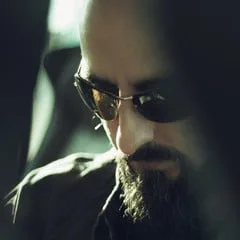
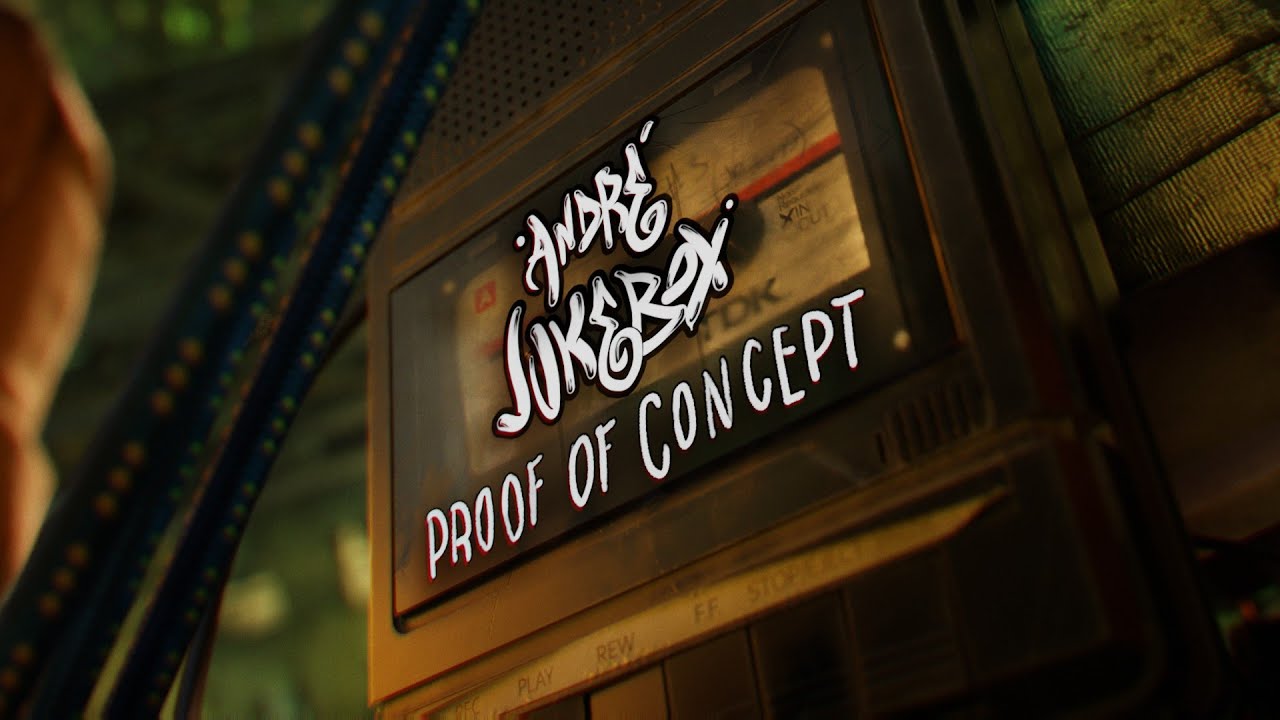
Jonathan W. Rodegher is an experienced Lighting Sequence Lead at Skydance Animation and a novice film maker. He has recently channeled his expertise into his latest personal project, the proof of concept André Jukebox. You can find more of his work on YouTube and Instagram. Below you can watch the short in its entirety.
"The best kind of lighting is usually the one that looks like it has a couple lights that just happened to look amazing, but if you see the actual setup it has a lot of work behind."
Jonathan W. Rodegher
The Proof of Concept: "André Jukebox"
It's been a long road to get here, hasn't it? How does it feel to finally see it finished?
Yeah it's been too long probably, but it got there. It feels great, after many many failed attempts and abandoned projects it has been a new feeling of satisfaction to finally be able to say I actually finished one. I can die in peace now. So in short, satisfaction and a bit of relief too.
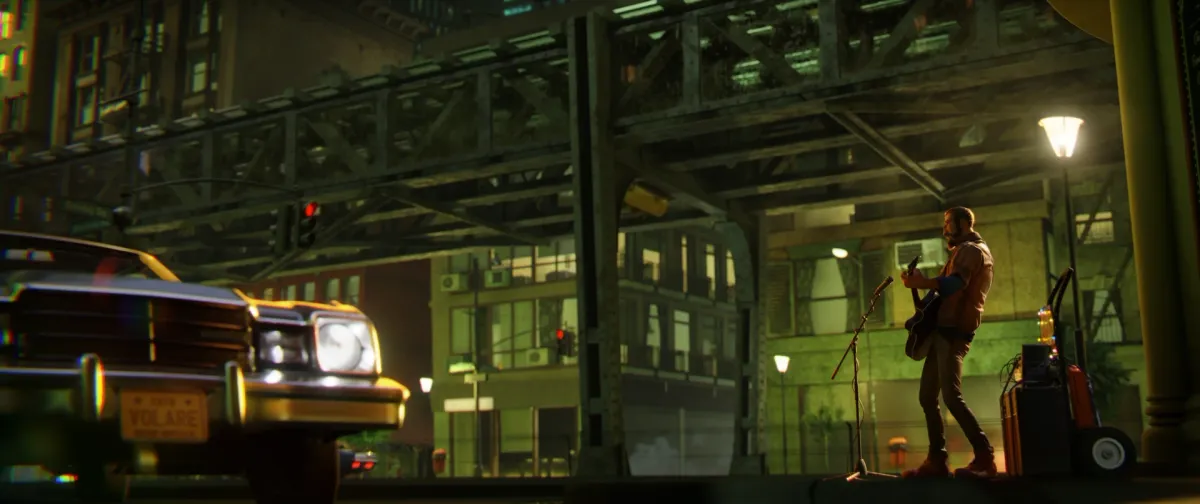
Still from André Jukebox. Image courtesy of Jonathan W. Rodegher.
Could you tell us how you managed to bring it to life both technically and artistically? What did your pipeline look like, and were there any specific artistic inspirations behind its unique look?
Technically speaking it has been a never ending string of problems basically, and more often than not problems you didn't expect. On the technical side I've done things quite manually for a good chunk of it. Exporting caches, creating scenes, splitting shots. And then I had quite a bit of help on the Katana side from co-workers to be able to automate tedious work and have some simple but really good templates.
Then I actually learnt a bit of python to do things like a custom multishot environment inside of Nuke, custom reads, etc. And I also got to create a render submitter for Katana shots and Deadline. I automated the whole thing. Going from 3D render, to Nuke renders, to symlink creations and the final QuickTimes.
The shot build is a mix of different sources, as USD wasn't as accessible to use when I first started the project. I have a mix of USD (the set is fully USD), Alembic caches, VDBs, XGen procedural, lookfiles from Katana for the whole shading side of things.
As for the artistic part, even if it doesn't really look like it, I'd say Spiderverse, Mielgo, Robert Valley (mostly for its camera work) have definitely been in the back of my head all the time. Fortiche I could say as well, I'm just a bit obsessed with things looking broken and dirty and grounded.
Many proof of concepts never make it past the concept stage because finishing a project of this scale is incredibly difficult. You had a great team of artists supporting you. Would you say that collaboration is the ultimate "tool" for actually getting a personal project across the finish line?
Yeah, I had a great support specially for the animation team, they really pushed ahead with the material they had to work with which wasn't great.
But everyone involved came in and put something from their part. It's always so cool that a lot of people are just willing to put their free time into something they feel excited about.
There were aspects of the project I could have never done even decently myself, so the final quality of the piece is the effort of a number of people. So at this point I'm not so sure I can call it a personal project anymore.
Is this the last we'll see of André, or are there plans to explore his world further in the future?
I already started working on the actual short film. Will I ever finish it? No idea, but I will try. If I get my way there will be plenty more of André and that includes a few new characters too.
The Craft of Lighting
How would you define "lighting" in your own words? Do you have a specific philosophy or a set of "golden rules" that guide your work?
I'm not really one for definitions to be honest. I'd say lighting is a bit of the art to accentuate and underline the dramatic intention of a given composition. What I usually don't like all that much about definitions is that if you read what I just wrote, it kind of puts you in the thought that you HAVE to emphasize something in particular, when sometimes the opposite might be true. Pretty much what kind of happens with music, where the silences are just as important if not more. In lighting sometimes the dramatic need of the shot is to be actually not very focused on anything in particular, but that's not the first thing that would come to mind if you read my "definition".
Golden rule? I like the idea of having no rules actually. I guess the worst thing you can do in (not only lighting) is being unintentionally confusing. As in having too many things at the same time, or when you force someone to make an actual effort to figure out what's going on. If you're intentionally doing that for the dramatic effect, then great. I guess out of this you can understand that the golden rule might be "always control the output". If you lose control, and whatever happens goes, then chances are your lighting is going to be less than ideal. But also far too much control will make your shot look synthetic and overly polished (which looks boring to me).
In your opinion, what is the fundamental difference between "good" lighting and "bad" lighting? How can you judge it?
Bad lighting is when you notice it, or it confuses you. To put a practical example, I'd say that if you got two characters talking in a shot, and the thing that picks up your attention is the glass far behind them, that has no dramatic intent and is irrelevant to the conversation, then you got a problem. If that's the brightest most contrasty point in the shot while being story-irrelevant, then you need to work on it. I also think that tweaking every pixel of a render to make it look "pretty" while losing light direction, overall consistency, depth, etc, that's also bad lighting.
Good lighting just feels natural. The best kind of lighting is usually the one that looks like it has a couple lights that just happened to look amazing, but if you see the actual setup it has a lot of work behind. That means that every light, fill, rims, shadows, all of it has been placed so tastefully that it will keep an apparent physicality to it while telling the story the shot needs and also achieving a pleasant imagery to the eye.
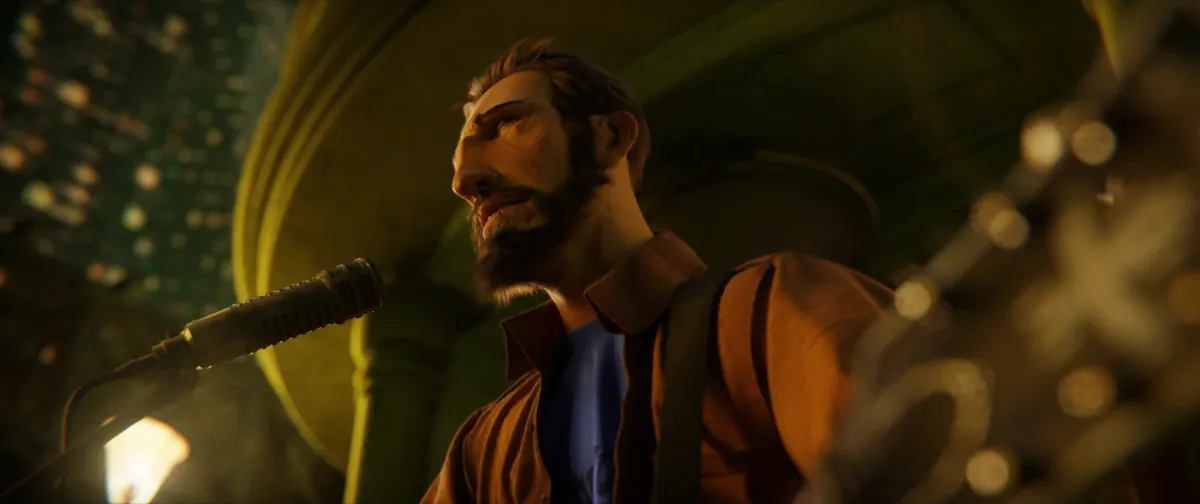
Still from André Jukebox. Image courtesy of Jonathan W. Rodegher.
Starting the Master Lighting for a new sequence can be quite daunting. How do you mentally and technically approach a fresh sequence to avoid that "creative vertigo"?
I have no idea where, but I read a long time ago a piece of advice that was pretty great. "When in doubt, always start by what you DO know". That's the way to overcome pretty much anything you need to figure out. The trick to figure things out, at least to me, is to do it. Worst thing you can do is to overthink it. Because you probably don't know enough about it to precisely calculate the consequences of everything you're doing. So think about it for a moment, and test small things. Just move forward, crash and burn, figure out why, and keep moving. Also get used to failing.
Technically, keep it as deadly simple as possible for as long as possible. If your first version in a sunset has 7 lights, it will be very cumbersome to make any changes. Also, lower expectations. Your very first versions will suck, no matter what. And even if you think they didn't, you'll realise they did when you see your final version. Another one, don't split everything in layers in the first steps either, that will just complicate things.
Also, all and any of these rules have exceptions, so a better use of them is to take them as general guides of what's ideal but keep in mind your next task; maybe you do need to separate all in layers as the first step to be able to do something.
Leadership and Career
Looking back, what was the real "game-changer" (skill or mindset) that helped you transition from being a Junior to an effective Lead? Tell us a bit about that journey.
I don't think I had a game changer. Usually what ends up taking you to lead or sup positions is experience, and maybe trying to think a bit beyond your actual tasks. A bit of "bigger-picture" like mentality.
How do you manage the teams under your leadership?
I like to give the artists freedom, and I like to believe I push them to think. It depends on your team as well, some people need more contention than others but ideally I absorb the pressure when there is some and I try to get problems out of the way so they can actually do some lighting.
Industry and Future
Do you feel major studios have been taking enough creative risks over the last decade? Is there anything you feel is currently missing or lacking in the modern animation industry?
I think the one studio pushing some boundaries is Sony right now, and maybe Dreamworks when they did Puss in Boots 2 / Bad Guys. Their storytelling feels snappy and modern and it's more on the risky side of things. Fortiche took a big risk, they grabbed an IP which millions of fans and bet everything on their ability to make the original lore justice while bringing in new audiences. It worked great for them. It's been really nice to see it develop in a time where there is a crisis on authenticity in general, not just animation but art in general. Working to please everyone just makes you bland.
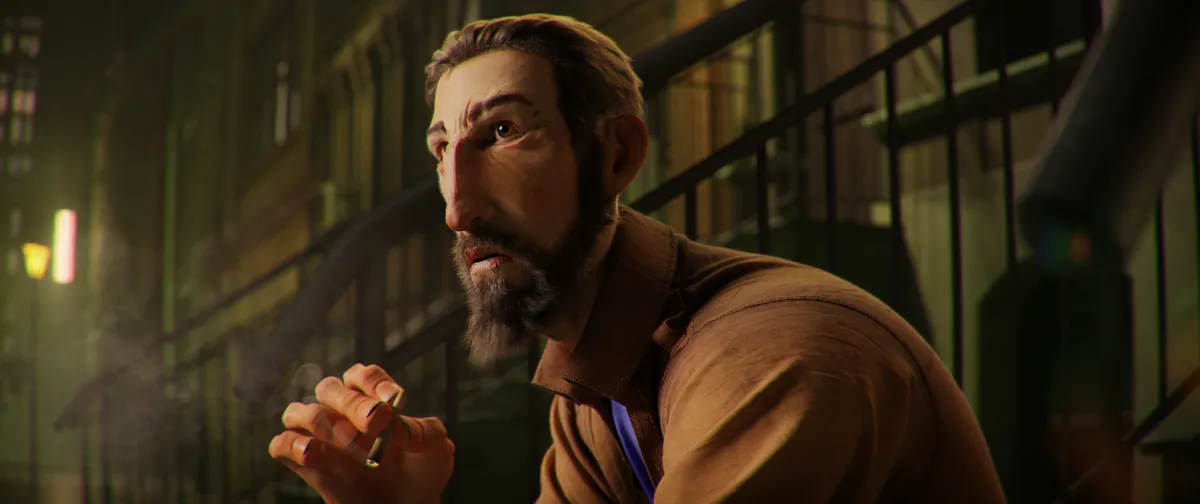
Still from André Jukebox. Image courtesy of Jonathan W. Rodegher.
Closing Thoughts
What's next for you? Are there any "dream projects" or personal goals you're looking to tackle next?
My next personal challenge is to be able to have a robust pipe, from start to finish. I'd like to get much better at making procedural environments. So many things... I need another brain.
Is there anything else you'd like to share? Any media, books, films, or artists that you think we should take a look at?
Yeah, look at independent animation a lot more. There are so many creators. That's where the good stuff is really at right now.
Another thing I'm always yapping about, is the real path to do anything. I feel like bigger companies are always showing their process as linear and perfect (for the sake of time as well) and this discourages people from making things because reality looks so different to this, it might feel like you suck. But the truth is things break all the time, and you will fail a lot. So what? Just keep getting at it.
Thank you, Jon.
Stay in the loop
New posts on lighting, art, and visual storytelling. No spam, just good reads.